Bone Weight Calculator: How Heavy Is Your Bazi?
ezfate's free bone weight calculator turns your solar or lunar birth date and birth hour into the four traditional weights for year, month, day and hour, adds them up in liang and qian, and shows the matching Yuan Tiangang poem with a plain-English reading and where your total sits among 876,588 birthdays. Free, no sign-up. The year changes at Chinese New Year by default; the leap-month, Start of Spring and 11 pm rules can all be switched.
Updated November 8, 2026
Birth details
ExampleRemoves daylight saving time automatically and lets you use true solar time.
The year changes at
Leap month
Born 23:00–24:00
Defaults: Chinese New Year, leap month split at the 16th, 11 pm births as the next day. When another rule would change your total, the result shows it.
Bone weight
Lunar date: 1990, month 2, day 19
3 liang 7 qian
3.7 liang · Easy come, easy go
- 年
庚午
9 qian
- 月
Month 2
7 qian
- 日
Day 19
5 qian
- 時
Si hour
1 liang 6 qian
- Year by Chinese New Year
Heavier than 32% of birthdays
4.6% of birthdays weigh exactly this
Bone weighing is a folk lookup method, shared here as cultural heritage and for reflection. It is not a prediction.
Poem for 3 liang 7 qian
Yuan Tiangang bone weight song (traditional attribution)
Easy come, easy go
In plain words
Nothing quite works out; brothers are little help and you walk alone. There is some inheritance, but it comes in clearly and goes out unnoticed.
Reading it today
Money that "leaves without a trace" is a nudge to keep accounts. See where it goes and more of it stays.
The same day at every hour
How the total changes with the birth hour. Tap a total to read its poem.
- early Zi hour00–013 liang 7 qian
- Chou hour01–032 liang 7 qian
- Yin hour03–052 liang 8 qian
- Mao hour05–073 liang 1 qian
- Chen hour07–093 liang
- Si hour09–113 liang 7 qian
- Wu hour11–133 liang 1 qian
- Wei hour13–152 liang 9 qian
- Shen hour15–172 liang 9 qian
- You hour17–193 liang
- Xu hour19–212 liang 7 qian
- Hai hour21–232 liang 7 qian
- late Zi hour23–24next day4 liang 7 qian
How bone weight is calculated: four weights added together
Chinese bone weighing (稱骨, cheng gu) gives the year, month, day and hour of birth a weight each; the sum is your bone weight. The units are the old liang (兩) and qian (錢): 10 qian make 1 liang.
- 1
Year: the year's stem and branch
Not just the zodiac animal but the full sexagenary year: Jia Zi (甲子) weighs 1.2 liang, Yi Chou (乙丑) 0.9 … Each animal comes in five versions over 60 years, all with different weights.
- 2
Month: the lunar month
The first month weighs 0.6; months 3 and 9 are the heaviest (1.8) and months 5 and 12 the lightest (0.5). Gregorian months cannot be used directly.
- 3
Day: the lunar day
Each of the 30 lunar days has a weight: days 18 and 26 are the heaviest (1.8), days 1 and 19 the lightest (0.5).
- 4
Hour: the double hour
The day has twelve two-hour periods. The Zi (11 pm–1 am) and Si (9–11 am) hours weigh most (1.6); the Chou, Xu and Hai hours least (0.6).
The calculator converts your Gregorian birthday to the lunar calendar, finds the year's stem and branch and the double hour, then looks up the four tables. Every value is published on the bone weight chart page so you can check each cell.
Worked example (follows the calculator above)
1990-03-15 10:30: 庚午 year (9 qian) + lunar Month 2 (7 qian) + Day 19 (5 qian) + Si hour (1 liang 6 qian) = 3 liang 7 qian.
Change the birthday or hour above and this line updates.
What counts as a heavy or light bone weight? 876,588 birthdays
We ran every day from 1900 to 2099 at each of the twelve hours (876,588 birthdays). The chart shows how often each total occurs.
- Median
- 4 liang
- Most common
- 3 liang 9 qian
- Lightest 8%
- ≤ 2 liang 9 qian
- Heaviest 12%
- ≥ 5 liang 1 qian
- Lowest possible
- 2 liang 1 qian
- Highest possible
- 7 liang 1 qian
There is no official line between light and heavy. In the data the median is 4.0 liang and the most common total is 3.9; about 8% of birthdays weigh 2.9 or less, about 12% weigh 5.1 or more, and only about 1% reach 6.0. The folk rule of thumb (under 3 liang is light, over 5 is heavy) roughly marks the lightest and heaviest tenth.
Heavier totals get grander poems, but that is how the poems are written, not a verdict on a life. Every verse has its own advice; read yours.
The 52 bone weight poems at a glance (2.1 to 7.2 liang)
One poem for every total from 2.1 to 7.2 liang, in five rough bands. Open the chart page for every poem with a translation.
2.1–3.0
Hard early years
Self-reliance, toil
Thin inheritance and little family help; life is built by your own effort, and several verses end with a settled old age.
11% of birthdays
Read these poems3.1–4.0
Struggle, then success
A midlife turn
Lines like "by middle age food and clothing come more easily" and "luck comes later": early effort pays off after midlife.
41% of birthdays
Read these poems4.1–5.0
Steady and growing
Ability, later luck
Talent, goodwill and a good old age are the themes; a few verses warn of thin family ties and the need to stand alone.
36% of birthdays
Read these poems5.1–6.0
A thriving household
Plenty, learning
More images of plenty, study and examination success; the household prospers and the name spreads.
11% of birthdays
Read these poems6.1–7.2
Wealth and high rank
Office, the very top
Imperial ranks and power stand for the greatest blessings; real birthdays rarely land in this range.
0.97% of birthdays
Read these poems
Low totals talk about hard early years and little family help, yet many end with a settled old age; high totals borrow imperial ranks and examination success. Rather than reading them as good or bad, read what each one asks of you.
Four rules that change the result: New Year or Start of Spring, leap months, the 11 pm hour and clock time
When the same birthday gives different weights on different sites, the reason is almost always one of these. We state what we use, and every rule can be switched under the calculator's settings; when a rule would change your total, the result says so.
Year: Chinese New Year or the Start of Spring?
Bone weighing uses the lunar month and day, so the year follows the lunar calendar too and changes at Chinese New Year, as in the Chinese almanac. Bazi charts change the year at the Start of Spring (around 4 February); the two can differ for births from late January to mid February.
ezfate default: Chinese New Year. Start of Spring can be switched on.
Leap month: this month or the next?
The usual rule weighs days 1–15 of a leap month as that month and days 16 onward as the next month; others weigh the whole leap month as its namesake. Leap month 2, day 20 weighs as month 3 (1.8) under the first rule and month 2 (0.7) under the second.
ezfate default: split at the 16th. Whole month can be switched on.
Born after 11 pm: same day or next day?
The Zi hour starts at 23:00. The traditional rule starts the new day with the Zi hour, so births after 23:00 take the next date and the next day's weight; others change the day at midnight.
ezfate default: next day, as in our Bazi calculator. Same day can be switched on.
Time: clock time, daylight saving and true solar time
The double hour is read from local standard time. Taiwan and Hong Kong used daylight saving time in some years up to 1979, and mainland China from 1986 to 1991; if you were born during DST, an hour comes off first.
Adding a birthplace removes daylight saving time automatically and lets you use true solar time instead.
Below the result we list what the other rule would give. If another site disagrees, check these four points first.
Can I calculate bone weight without a birth time?
Yes. The year, month and day weights do not need the hour, so the calculator adds each of the twelve hours in turn and shows the range. Choose "Don't know" and you get 13 totals (early Zi, Chou through Hai, and late Zi, which counts as the next day); it never assumes noon.
If you remember roughly when (morning, afternoon, night), look only at those rows, or check with family or a birth record. To see which double hour a clock time belongs to, use the Chinese hours chart.
What is Chinese bone weight fortune telling?
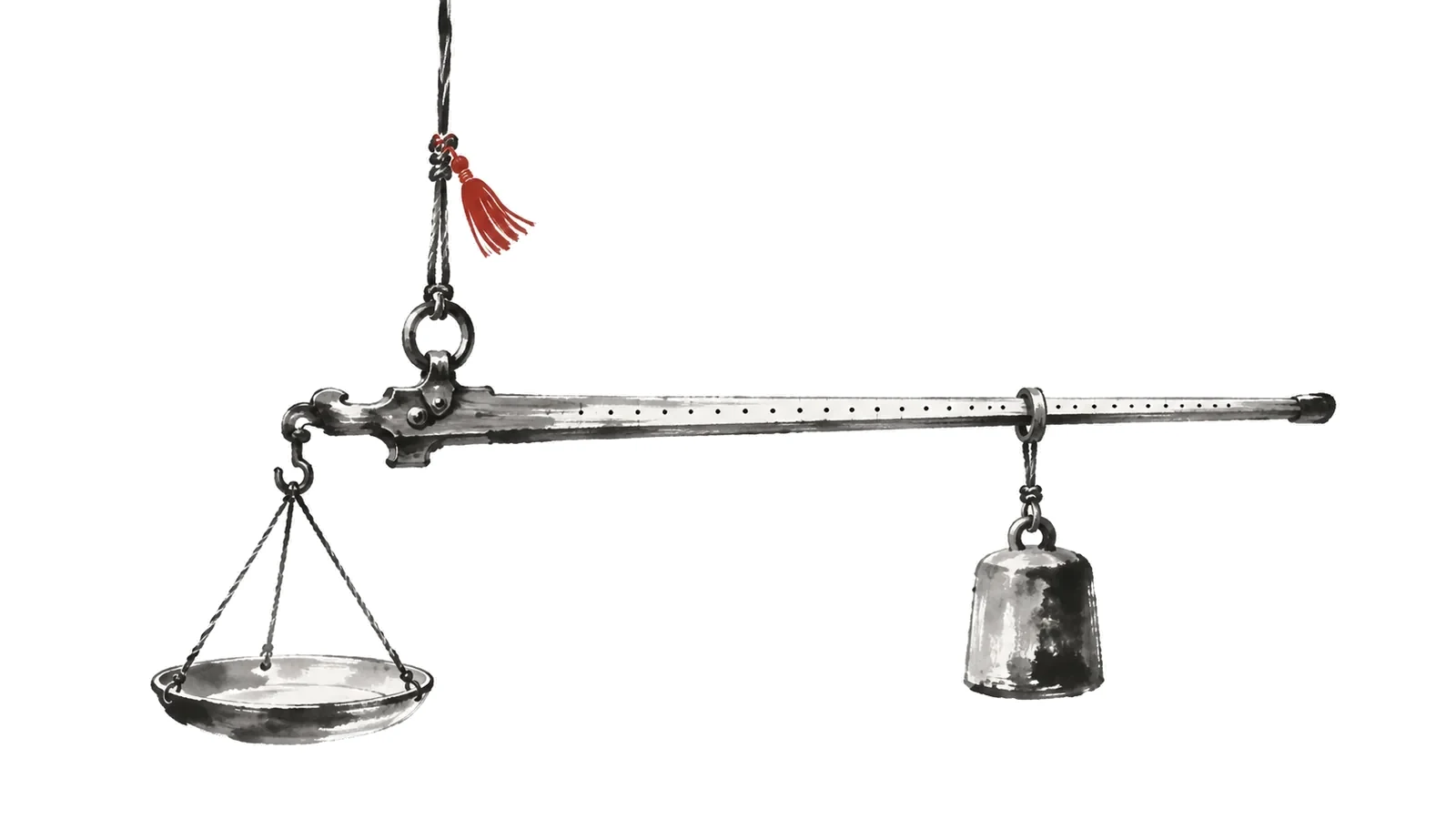
Bone weight (八字重量, 骨重, 稱骨) is a folk lookup method: the year, month, day and hour of birth become four weights, and their sum points to a four-line poem that sums up the shape of a life.
Tradition credits it to Yuan Tiangang, a Tang dynasty physiognomist. The Old and New Books of Tang do record Yuan Tiangang (袁天綱) as a famous face reader, but say nothing about bone weighing; the four tables and 52 poems were attributed to him later and passed down in almanacs, with small differences in wording between editions.
Why "bone weighing"?
A person's lot was said to be light or heavy, as if weighed on a steelyard, so the result is given in the old weight units liang and qian.
Bone weight and Bazi
Bazi (eight characters) are the stems and branches of the four pillars. Bone weighing borrows only the year's stem and branch and the hour, and uses the lunar month and day, so it is a separate method from a Bazi chart.
52 poems
One poem for each total from 2.1 to 7.2 liang. With the standard tables the highest reachable total is 7.1, so the 7.2 poem is never actually reached.
Is a light bone weight unlucky? Folk beliefs
In Taiwan you may hear that people with a "light" bazi are more sensitive to spirits, and that heavy ones are better protected. It is a folk belief; the poems say nothing of the kind and there is no evidence for it. Bone weight is a sum of four table values, not a measure of health, nerve or luck.
A light total is nothing to worry about, and a heavy one is no promise. Sleep, health and the choices you make matter far more.
Is bone weight accurate? How it differs from a Bazi chart
Bone weight is a fixed lookup, best enjoyed as cultural heritage and a prompt for reflection, not a prediction.
Bone weight: one poem for a life
Four numbers added together; everyone born on the same day and hour gets the same result. There is no statistical or empirical basis.
Bazi chart: the whole picture
The four pillars' stems and branches, five-element balance, Day Master strength, ten gods and ten-year luck pillars, read separately for personality, work, love and each year.
The two methods need not agree. For a fuller picture, run a free Bazi chart from the same birth details; chapter 1 of the AI reading is free with an account.
Bone weight FAQ
How it is calculated, what counts as heavy, and what to do with an unknown hour, an 11 pm birth or a leap month.
Sources and method
Where the tables, poems and numbers on this page come from.
- 01《Old Book of Tang and New Book of Tang (biographies of Yuan Tiangang)》Record Yuan Tiangang as a physiognomist; the bone weight tables and poems are not in the official histories and were attributed to him later.
- 02《Almanac (通書, 農民曆) bone weight tables》The four tables use the common values; poem wording differs slightly between editions and we use the most widely printed one.
- 03《ezfate calendar engine》Solar–lunar conversion, the Start of Spring, time zones and daylight saving time, and the distribution over 876,588 birthdays are computed by our engine.
Beyond the poem
One poem for a whole life is a start. Your chart says much more.
The free Bazi chart reads the same birth details as four pillars, five elements, Day Master strength and ten-year luck pillars. The AI reading explains it in plain words, chapter by chapter.
Free to start · $2.99 for all six chapters
More free tools
- 12 Chinese hours chartWhich double hour you were born in, with true solar time and your hour pillar.
- Bazi CalculatorFour Pillars, ten gods, hidden stems, element balance and luck pillars. Free, and no sign-up.
- Five Elements CalculatorFind your element, the balance of Wood, Fire, Earth, Metal and Water in your chart, and what is missing.
- The ten Day MastersThe stem of your birth day: who you are in the chart.
- Luck pillar start ageWhen your ten-year luck pillars begin, and how to calculate it.
- Zi Wei Dou ShuThe Purple Star chart of twelve palaces.