The 12 Chinese Hours: Clock Times and Your Birth Hour
ezfate's Chinese 12 hours chart maps the 24-hour day onto the twelve double hours (shichen), Zi to Hai, with each hour's clock time, halves, animal, element and old name. Enter a birth date, time and birthplace and it converts to true solar time, then tells you which double hour you were born in and your Bazi hour pillar. Free, no sign-up; the dial's hand shows the Chinese hour right now.
Updated November 8, 2026
The 12 hours right now
Tap an hour
Wei hour
- Clock time
- 13:00–15:00
- Halves
- Wei chu 13:00 · Wei zheng 14:00
- Animal
- Goat
- Element
- Earth
- Old name
- Sun declining (日昳)
- Organ clock
- Small intestine
The organ clock (子午流注) is a traditional Chinese medicine association, listed for culture, not as health advice.
Grey hand: your clock now. Red hand: the birth time on the right (after true solar time). Tap a sector for its details.
Which Chinese hour was I born in?Example
Born in the
Wei hourWei zheng
13:00–15:00
- Time used: 14:39 · true solar time +9.8 min
Day changes at 23:00
Day pillar
丁丑
Hour pillar
丁未
Day changes at midnight
Day pillar
丁丑
Hour pillar
丁未
Both day-boundary conventions agree for this time.
Open this birth in the Bazi calculatorChinese 12 hours chart: times, animals and elements
Each double hour lasts two hours. The day starts with the Zi hour at 11 pm, followed by Chou, Yin, Mao, Chen, Si, Wu, Wei, Shen, You, Xu and Hai. The chart gives each hour's clock time, its two halves (chu and zheng), animal, element, old name and organ-clock meridian.
| Double hour | Clock time | Halves (chu / zheng) | Animal | Element | Old name | Organ clock |
|---|---|---|---|---|---|---|
| 子Zi hour | 23:00–01:00 | Zi chu 23 · Zi zheng 00 | Rat | Water | Midnight (夜半) | Gallbladder |
| 丑Chou hour | 01:00–03:00 | Chou chu 01 · Chou zheng 02 | Ox | Earth | Cockcrow (雞鳴) | Liver |
| 寅Yin hour | 03:00–05:00 | Yin chu 03 · Yin zheng 04 | Tiger | Wood | Dawn (平旦) | Lung |
| 卯Mao hour | 05:00–07:00 | Mao chu 05 · Mao zheng 06 | Rabbit | Wood | Sunrise (日出) | Large intestine |
| 辰Chen hour | 07:00–09:00 | Chen chu 07 · Chen zheng 08 | Dragon | Earth | Breakfast (食時) | Stomach |
| 巳Si hour | 09:00–11:00 | Si chu 09 · Si zheng 10 | Snake | Fire | Late morning (隅中) | Spleen |
| 午Wu hour | 11:00–13:00 | Wu chu 11 · Wu zheng 12 | Horse | Fire | Midday (日中) | Heart |
| 未Wei hour | 13:00–15:00 | Wei chu 13 · Wei zheng 14 | Goat | Earth | Sun declining (日昳) | Small intestine |
| Shen hour | 15:00–17:00 | Shen chu 15 · Shen zheng 16 | Monkey | Metal | Late afternoon (晡時) | Bladder |
| You hour | 17:00–19:00 | You chu 17 · You zheng 18 | Rooster | Metal | Sunset (日入) | Kidney |
| 戌Xu hour | 19:00–21:00 | Xu chu 19 · Xu zheng 20 | Dog | Earth | Dusk (黃昏) | Pericardium |
| 亥Hai hour | 21:00–23:00 | Hai chu 21 · Hai zheng 22 | Pig | Water | Bedtime (人定) | Triple burner |
An easy way to remember it: Zi starts at 23:00 and the branch changes every two hours; odd hours are the first half (chu), even hours the second (zheng), so 13:00 is Wei chu and 14:00 Wei zheng. The highlighted row is the birth time in the finder above.
What time is each Chinese hour?
The twelve double hours one by one. Tap a sector on the dial for the same details.
Zi hour (Rat): 11 pm to 1 am
23:00–01:00
The first double hour, once called midnight (夜半). 23:00–24:00 is Zi chu, the late Zi hour; 00:00–01:00 is Zi zheng, the early Zi hour. Animal Rat, element Water.
Chou hour (Ox): 1 am to 3 am
01:00–03:00
Called cockcrow (雞鳴), when roosters begin to call. Chou chu is 1:00, Chou zheng 2:00. Animal Ox, element Earth.
Yin hour (Tiger): 3 am to 5 am
03:00–05:00
Called dawn (平旦), before first light. Yin chu is 3:00, Yin zheng 4:00. Animal Tiger, element Wood; the Tiger month opens the year, and this hour was seen as the day's rising energy.
Mao hour (Rabbit): 5 am to 7 am
05:00–07:00
Called sunrise (日出). Mao chu is 5:00, Mao zheng 6:00. Animal Rabbit, element Wood. Officials answered roll call in this hour.
Chen hour (Dragon): 7 am to 9 am
07:00–09:00
Called mealtime (食時), the time for breakfast. Chen chu is 7:00, Chen zheng 8:00. Animal Dragon, element Earth.
Si hour (Snake): 9 am to 11 am
09:00–11:00
Called the corner of noon (隅中), as the sun nears its height. Si chu is 9:00, Si zheng 10:00. Animal Snake, element Fire; in bone weighing it is one of the two heaviest hours.
Wu hour (Horse): 11 am to 1 pm
11:00–13:00
Called midday (日中); Wu zheng is exactly noon, and the Chinese words for noon come from this hour. Animal Horse, element Fire, the peak of the day's yang.
Wei hour (Goat): 1 pm to 3 pm
13:00–15:00
Called the sun's decline (日昳), as it starts to sink west. Wei chu is 13:00, Wei zheng 14:00. Animal Goat, element Earth.
Shen hour (Monkey): 3 pm to 5 pm
15:00–17:00
Called the late meal (晡時), the old second meal of the day. Shen chu is 15:00, Shen zheng 16:00. Animal Monkey, element Metal.
You hour (Rooster): 5 pm to 7 pm
17:00–19:00
Called sunset (日入). You chu is 17:00, You zheng 18:00. Animal Rooster, element Metal. A rooster-hour birth is "rooster hour" in English Bazi guides.
Xu hour (Dog): 7 pm to 9 pm
19:00–21:00
Called dusk (黃昏). Xu chu is 19:00, Xu zheng 20:00. Animal Dog, element Earth; also the first watch of the night.
Hai hour (Pig): 9 pm to 11 pm
21:00–23:00
Called settling down (人定), when the household goes quiet for the night. Hai chu is 21:00, Hai zheng 22:00. Animal Pig, element Water; after it comes the next day's Zi hour.
The Zi hour and the day boundary: early and late Zi
The Zi hour crosses midnight, the only double hour that spans two dates, so Bazi has two ways to set the day pillar.
New day at 23:00
From 23:00 the birth counts as the next day: the day pillar moves on and the hour pillar follows the next day's stem. This is the most common rule.
Default in ezfate's Bazi calculator and bone weight calculator.
New day at midnight (early and late Zi)
23:00–24:00 is the late Zi hour: the day pillar stays on the current day while the hour stem follows the next day. 00:00–01:00 is the early Zi hour on the new day.
Can be switched in the Bazi calculator's settings.
For births between midnight and 1 am both rules agree; only 11 pm to midnight is affected.
True solar time: the hour follows the sun at your birthplace
Clock time is the same across a whole time zone, but the sun reaches its highest point at different times in different cities. The Chinese hours traditionally follow the sun, so birth times are often converted to true solar time first.
True solar time = standard time + longitude offset + equation of time. The longitude offset is 4 minutes for every degree between the birthplace and its zone's central meridian: Taipei (121.5°E) is east of UTC+8's 120°E, so its sun runs about 6 minutes ahead; Urumqi (87.6°E) keeps Beijing time and runs over two hours behind. The equation of time, from the shape of Earth's orbit, adds −14 to +16 minutes over the year.
For most people the correction is a few minutes to twenty; it only changes the double hour when the birth time is near a boundary such as 12:55 or 14:58. Add a birthplace in the finder above and it converts automatically; the table gives the offsets for major cities.
Should you use true solar time?
Most Bazi and Zi Wei schools use it; bone weighing and folk date-picking usually read the clock. Our Bazi calculator uses true solar time by default and lets you switch it off to compare.
Remove daylight saving time first
Taiwan and Hong Kong used daylight saving time in some past years and mainland China from 1986 to 1991. An hour comes off before converting; the finder does it when you add a birthplace.
| City | Longitude | Longitude offset | Over the year |
|---|---|---|---|
| Taipei | 121.6°E | +6.2 | −8 ~ +22.6 |
| Kaohsiung | 120.3°E | +1.2 | −13 ~ +17.6 |
| Hong Kong | 114.2°E | −23.3 | −37.5 ~ −6.9 |
| Macau | 113.5°E | −25.8 | −40 ~ −9.4 |
| Shanghai | 121.5°E | +5.9 | −8.3 ~ +22.3 |
| Beijing | 116.4°E | −14.4 | −28.6 ~ +2 |
| Guangzhou | 113.3°E | −27 | −41.2 ~ −10.6 |
| Chengdu | 104.1°E | −63.7 | −77.9 ~ −47.3 |
| Urumqi | 87.6°E | −129.5 | −143.7 ~ −113.1 |
| Singapore | 103.8°E | −64.7 | −78.9 ~ −48.3 |
| Kuala Lumpur | 101.7°E | −73.2 | −87.4 ~ −56.8 |
| Tokyo | 139.7°E | +18.8 | +4.6 ~ +35.2 |
| Osaka | 135.5°E | +2 | −12.2 ~ +18.4 |
| Sapporo | 141.3°E | +25.4 | +11.2 ~ +41.8 |
| Naha | 127.7°E | −29.3 | −43.5 ~ −12.9 |
| Seoul | 127.0°E | −32.1 | −46.3 ~ −15.7 |
| London | 0.1°W | −0.5 | −14.7 ~ +15.9 |
| New York | 74.0°W | +4 | −10.2 ~ +20.4 |
| Vancouver | 123.1°W | −12.5 | −26.7 ~ +3.9 |
| Sydney | 151.2°E | +4.8 | −9.4 ~ +21.2 |
True solar time minus standard time in minutes: the longitude offset (4 minutes per degree from the zone's meridian) plus the equation of time (−14 to +16 minutes over the year). Without daylight saving time.
From hour to hour pillar: the hour stem table
The hour pillar's branch is the double hour itself; its stem depends on the day stem, by the rule called Five Rats (五鼠遁): Jia and Ji days start the Zi hour at Jia Zi, Yi and Geng days at Bing Zi, Bing and Xin days at Wu Zi, Ding and Ren days at Geng Zi, Wu and Gui days at Ren Zi.
| Day stem | 子23 | 丑01 | 寅03 | 卯05 | 辰07 | 巳09 | 午11 | 未13 | 申15 | 酉17 | 戌19 | 亥21 |
|---|---|---|---|---|---|---|---|---|---|---|---|---|
| 甲己 | 甲子 | 乙丑 | 丙寅 | 丁卯 | 戊辰 | 己巳 | 庚午 | 辛未 | 壬申 | 癸酉 | 甲戌 | 乙亥 |
| 乙庚 | 丙子 | 丁丑 | 戊寅 | 己卯 | 庚辰 | 辛巳 | 壬午 | 癸未 | 甲申 | 乙酉 | 丙戌 | 丁亥 |
| 丙辛 | 戊子 | 己丑 | 庚寅 | 辛卯 | 壬辰 | 癸巳 | 甲午 | 乙未 | 丙申 | 丁酉 | 戊戌 | 己亥 |
| 丁壬 | 庚子 | 辛丑 | 壬寅 | 癸卯 | 甲辰 | 乙巳 | 丙午 | 丁未 | 戊申 | 己酉 | 庚戌 | 辛亥 |
| 戊癸 | 壬子 | 癸丑 | 甲寅 | 乙卯 | 丙辰 | 丁巳 | 戊午 | 己未 | 庚申 | 辛酉 | 壬戌 | 癸亥 |
Find your day stem's row and your hour's column. The highlighted cell is the birth in the finder above.
Year pillar
Changes at the Start of Spring; ancestry and early life.
Month pillar
Changes at the solar terms; parents, upbringing and youth.
Day pillar
Changes at the Zi hour. The day stem is the Day Master; the day branch is the spouse palace.
Hour pillar
Branch from the birth hour, stem from the Five Rats rule; children, later life and where your ideas land.
For example, on a Jia or Ji day the Zi hour is Jia Zi and the Wu hour Geng Wu; on a Yi or Geng day the Zi hour is Bing Zi. Year, month, day and hour pillars together make the eight characters, the bazi. Open your full chart from the finder above.
Does your birth hour shape your destiny?
People often ask which birth hour is luckiest. The hour is one pillar of four and only makes sense with the other three.
In Bazi the hour pillar is the palace of children and later life, and of where a person's ideas and work end up. The ten-god relation between the hour stem and the Day Master traditionally describes how you act: an Eating God on the hour is said to favour expression and enjoyment, Seven Killings decisive action.
The same hour means something different for each Day Master, so reading destiny from the hour alone is unreliable. Popular lines about people born in the Rat hour or the Horse hour are mostly animal and element associations.
What if you don't know your birth time?
Ask family, or check a birth certificate or hospital record; they often note the time. If you cannot find it, Bazi can still be read from three pillars (year, month, day): the Day Master, element balance and luck pillars remain, only the hour pillar is missing.
Bone weight can be worked out for all twelve hours to show the possible range. Zi Wei Dou Shu depends almost entirely on the hour, so it is best left until the time is known.
Shichen, ke and geng: how time was kept in old China
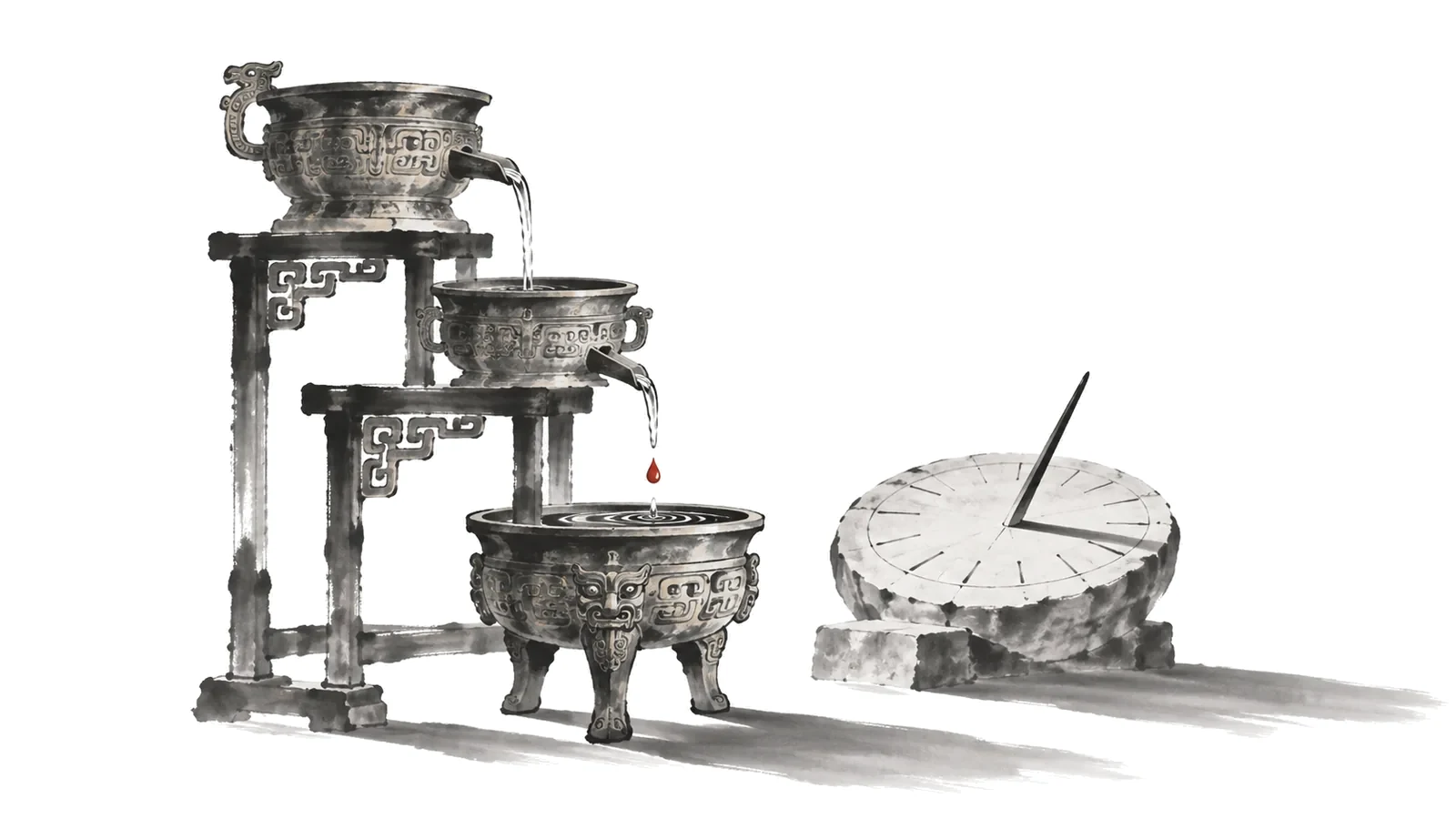
A double hour equals two modern hours. Water clocks also divided the day and night into 100 ke of about 14.4 minutes; in the Qing dynasty this became 96 ke of exactly 15 minutes, which is why a ke (一刻) means a quarter of an hour today.
The night was split into five watches (geng): the first about 19–21 (Xu), the second 21–23 (Hai), the third 23–1 (Zi), the fourth 1–3 (Chou) and the fifth 3–5 (Yin). "The third watch of the night" means the Zi hour.
Three ke into the Wu hour
About 11:45, close to noon: the time old novels give for executions, when the sun is highest and shadows shortest.
Roll call at Mao
Officials reported for duty in the Mao hour (5–7 am); 点卯 still means clocking in.
Night watchmen
Watchmen struck a wooden clapper once per watch, which is where the five geng of the night come from.
Chinese hours FAQ
Converting the twelve hours to clock time, finding your birth hour, true solar time and the hour pillar.
Sources and method
Where the times, names and calculations on this page come from.
- 01《Old names of the twelve hours》Midnight, cockcrow, dawn, sunrise, mealtime, late morning, midday, sun declining, late meal, sunset, dusk, settling down: names in use since the Han dynasty, spelled slightly differently between texts.
- 02《Five Rats rule (五鼠遁)》The traditional rule for the hour stem; our Bazi calculator computes the same values.
- 03《Organ clock (子午流注)》Traditional Chinese medicine's pairing of the twelve meridians with the twelve hours, listed as culture only.
- 04《ezfate calendar engine》True solar time (longitude and equation of time), time zones and daylight saving time, day and hour pillars.
From the hour to the chart
Your birth hour is one pillar of four.
The free Bazi chart puts the hour pillar next to the year, month and day pillars, with true solar time from your birthplace, five-element balance and ten-year luck pillars. The AI reading explains it chapter by chapter.
Free to start · $2.99 for all six chapters
More free tools
- Bone weight calculatorYour bazi weight in liang and qian, with the Yuan Tiangang poem and the four tables.
- Bazi CalculatorFour Pillars, ten gods, hidden stems, element balance and luck pillars. Free, and no sign-up.
- Five Elements CalculatorFind your element, the balance of Wood, Fire, Earth, Metal and Water in your chart, and what is missing.
- The ten Day MastersThe stem of your birth day: who you are in the chart.
- Luck pillar start ageWhen your ten-year luck pillars begin, and how to calculate it.
- Zi Wei Dou ShuThe Purple Star chart of twelve palaces.