Zi Wei Dou Shu Compatibility: Free Purple Star Chart Match
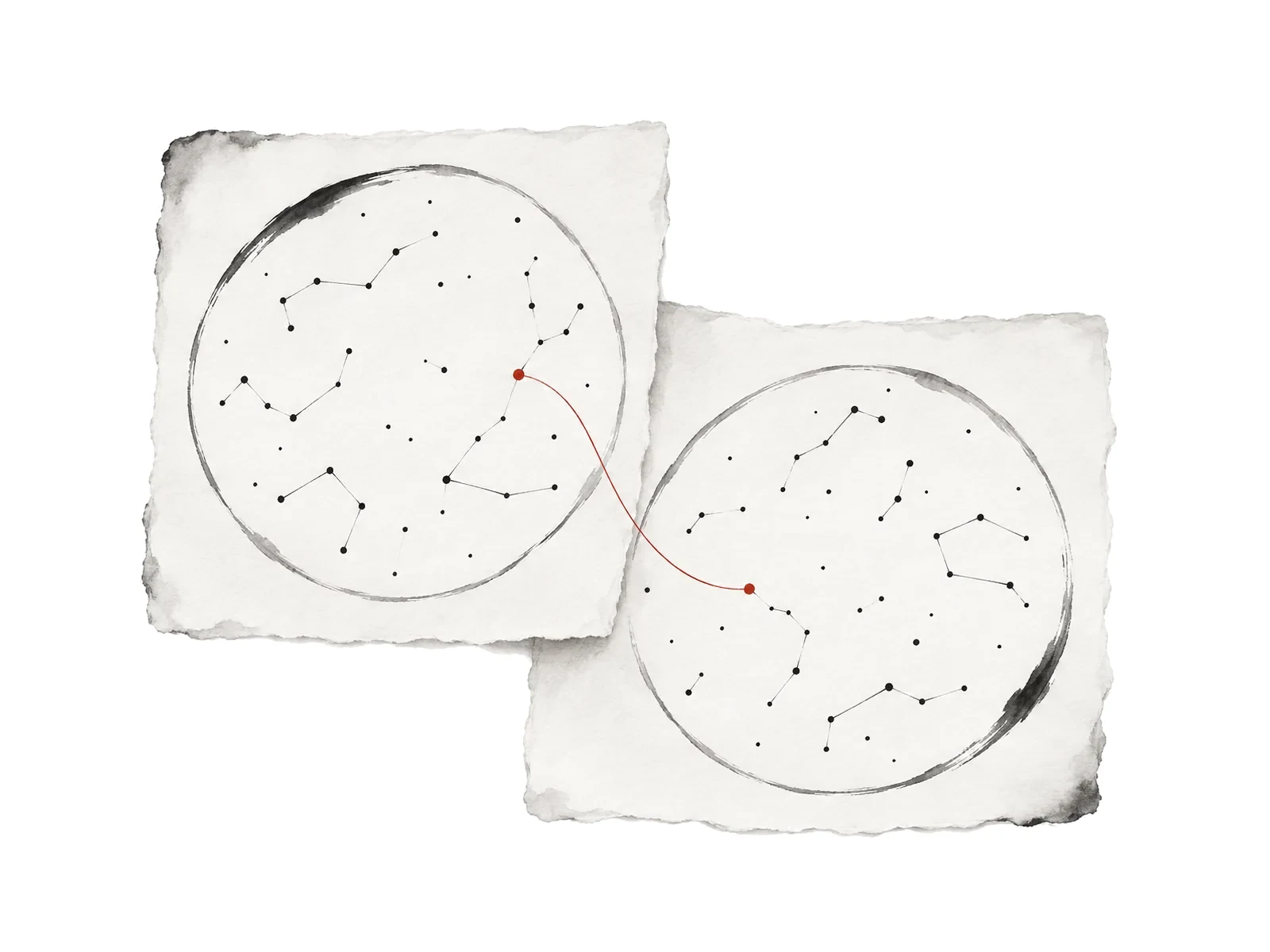
ezfate’s free Zi Wei Dou Shu compatibility tool turns two birth dates and hours into two Purple Star charts side by side and compares them six ways, from both sides: where each Life palace lands in the other chart, the Spouse palace stars against the partner’s Life palace, the birth-year Si Hua flying into the other chart, the two Life-palace branches, the peach-blossom stars and the malefics Qing Yang and Tuo Luo. Free, no sign-up, calculated in your browser; it counts supportive, two-sided and friction signals and never turns them into a made-up percentage.
- Zi Wei Dou Shu compatibility
- Purple Star Astrology
- Spouse palace
- Si Hua
- Couple chart
Updated November 8, 2026
Relationship
Each chart’s Spouse palace stands for the other person.
Both charts are calculated in your browser. Birth details stay on this device unless you save them to an account.
Example pair
CoupleSignals in six factors
Strongest link: Your partner’s Ju Men Hua Lu lands in You’s Fortune Palace.
A count, not a percentage: each signal below says where it comes from.
Your partner
Life palace 亥: Lian Zhen, Tan Lang
Empty Life palace, borrows the opposite · Wood 3 bureau
Open the full chartBoth charts side by side
Each board is one person’s chart with the other drawn on it: the palace that stands for the other person is outlined, their Life palace is tagged, and their birth-year transformations are listed where they land.
You’s chart
Earth 5 bureau
Outlined: Spouse Palace · B: the other person
Your partner’s chart
Wood 3 bureau
Outlined: Spouse Palace · A: the other person
Tags like “B Life” mark where the other person’s Life palace falls; entries like “B·Tai Yin 祿” are their birth-year transformations landing in this chart.
Six factors, both directions
Every factor is read from each side, because a link rarely runs equally both ways. Each line names the palace or star it rests on.
Where each Life palace lands
Lay the two charts on top of each other by branch: the palace of my chart that sits on your Life palace’s branch describes how I experience you.
- Neutral
You’s Life palace (戌) falls in Your partner’s Siblings Palace.
Read like a sibling or a peer: easy, familiar company, more side by side than face to face.
Read more · Siblings Palace - Neutral
Your partner’s Life palace (亥) falls in You’s Parents Palace.
The Parents palace: guidance and authority — one feels like a mentor or a rule-setter to the other.
Read more · Parents Palace
Spouse Palace stars and the other’s Life palace
The palace that stands for the other person describes the kind of person you are drawn to in that role. Compare its main stars with the other’s Life palace stars (an empty palace borrows the opposite palace’s stars).
- Neutral
You’s Spouse Palace: Tian Tong, Tian Liang (borrowed) · Your partner’s Life palace: Lian Zhen, Tan Lang (borrowed)
Different types. Most pairs look like this; it means the palace’s picture and the person differ, not that the match is poor.
- Neutral
Your partner’s Spouse Palace: Wu Qu, Qi Sha · You’s Life palace: Tai Yin
Different types. Most pairs look like this; it means the palace’s picture and the person differ, not that the match is poor.
Birth-year transformations into the other chart
Each birth-year stem turns four stars into Lu, Quan, Ke and Ji. Find those stars in the other chart: landings in the other’s Life palace, the palace standing for you, or the Fortune palace are counted.
You’s birth-year stem in Your partner’s chart
- 祿Tai Yang → Siblings Palacenot counted
- 權Wu Qu → Spouse PalaceHua Quan in a key palace: influence — You pushes, directs or takes charge here; helpful or controlling depending on how it’s used.Two-sided
- 科Tai Yin → Friends Palacenot counted
- 忌Tian Tong → Children Palacenot counted
Your partner’s birth-year stem in You’s chart
- 祿Ju Men → Fortune PalaceHua Lu in a key palace: Your partner brings ease, warmth or resources to this part of You’s life.Supportive
- 權Tai Yang → Travel Palacenot counted
- 科Artistry Star → Parents Palacenot counted
- 忌Literary Star → Friends Palacenot counted
The two Life palace branches
Six Harmony between the two Life palaces reads as an easy fit; Six Harm and Punishment as friction. Same branch, clash and trines already show in factor 1.
- Neutral
戌 and 亥: no Six Harmony, Harm or Punishment between them.
Peach-blossom stars on the other chart
Hong Luan and Tian Xi are the classic romance stars. When one person’s falls on the other’s Life or Spouse palace, tradition reads it as attraction.
- Supportive
You’s 紅鸞 falls on Your partner’s Spouse Palace.
- Supportive
Your partner’s 紅鸞 falls on You’s Spouse Palace.
Qing Yang and Tuo Luo on the other chart
Qing Yang (the Ram) and Tuo Luo (the Spinning Top) are malefics. When one person’s falls on the other’s Life palace or the palace standing for them, tradition reads friction: sharp words, pressure or delays between them.
- Friction
You’s Goat Blade falls on Your partner’s Spouse Palace.
- Friction
Your partner’s Goat Blade falls on You’s Life Palace.
- Friction
Your partner’s Delay falls on You’s Spouse Palace.
Shown, not counted
Context some teachers add. It is listed so you can see it, and left out of the count.
Shared branches
No shared branch among the Body, Fortune and partner palaces.
Five-element bureaus
Your partner Wood 3 bureau restrains You Earth 5 bureau (controlling cycle).
The decade each is in
You: nominal age 37, the decade of the Children Palace (ages 35–44).
Your partner: nominal age 36, the decade of the Children Palace (ages 33–42).
Go further
Read each chart in full, or check the pair with Bazi
The comparison shows where the two charts touch. The readings explain what each chart says about love and partnership; the Bazi comparison is a second, independent lens on the same two people.
- Zi Wei reading: love chapterSee a full sample reading first, then read your own chart.Open the reading
- Bazi compatibility readingFive chapters on the same pair from their Four Pillars: overview, how you get along, attraction, friction and timing.Open
- Compare with Bazi, freeDay Masters, spouse palaces, elements and zodiac signs, scored with every factor shown.Open
Readings: chapter 1 is free with an account.
How to read a Zi Wei Dou Shu compatibility chart: six checks
Zi Wei compatibility (紫微合盤, he pan) doesn’t merge two charts into one. It keeps both and looks at where they touch. These are the six traditional cross-chart checks the tool runs — each from both sides, because a link between two people is rarely equal both ways.
- 1
Life palace overlay: lay one chart on the other by branch and see which of your palaces the other person’s Life palace falls in. The Spouse, Fortune and Property palaces count most.
- 2
Spouse palace stars: your Spouse palace describes the kind of person you are drawn to. Compare its stars with the other person’s Life palace stars.
- 3
Birth-year transformations: your birth-year stem turns four stars into Lu, Quan, Ke and Ji. Find those stars in the other chart and see which palaces they land in.
- 4
Life palace branches: Six Harmony between the two Life palaces reads as an easy fit; Six Harm and Punishment as friction.
- 5
Peach-blossom stars: one person’s Hong Luan or Tian Xi on the other’s Life or Spouse palace is the classic sign of attraction (couples only).
- 6
Qing Yang and Tuo Luo: one person’s Ram or Spinning Top on the other’s Life palace, or the palace standing for them, is the classic friction marker — sharp words, pressure or delays.
Where each Life palace lands: the overlay method
Each of the twelve palaces sits on one earthly branch, and the branches sit in the same places in every chart, so two charts can be laid on top of each other. If your partner’s Life palace is in Wu, the palace on Wu in your chart describes how you experience them. In your Spouse palace, they feel like the partner your chart describes; in your Fortune palace, time together feels restful; in your Property palace, building a home comes naturally.
In your Life palace, the two Life palaces share a branch: alike, quick to understand each other, prone to the same blind spots. In your Travel palace, the two Life palaces clash: opposites attract, push and pull, and the other person widens your world. Always read both directions — landing in your Spouse palace doesn’t mean you land in theirs, and that imbalance is often what the relationship is about.
Spouse palace stars and the partner’s Life palace
The Spouse palace doesn’t name your future partner. It describes what draws you in a close relationship and what you expect from it. Tian Ji there leans towards clever, quick people; Tian Fu towards steady, dependable ones. Compare your Spouse palace stars with the partner’s Life palace stars: the same star means they are exactly that type; the same star family (Zi Wei–Tian Fu, Sha Po Lang, Ji Yue Tong Liang, Ju Men–Tai Yang) means a similar temperament.
Different types are the most common result and are not a warning: in many good marriages the Spouse palace’s picture and the real partner differ. An empty Spouse palace borrows the stars of the palace opposite (the Career palace); the tool marks those as borrowed.
Birth-year Si Hua in the other chart: who brings what
Every birth-year stem transforms four stars — someone born in a Jia year has Lian Zhen Hua Lu, Po Jun Hua Quan, Wu Qu Hua Ke and Tai Yang Hua Ji. The same star sits in a different palace in each chart, so placing your four transformations in the other person’s chart shows which part of their life you affect.
Hua Lu in their Life, Spouse or Fortune palace is read as giving and ease; Hua Ke as respect and reason; Hua Quan as influence — help or control depending on how it’s used; Hua Ji as attachment and debt — you care a lot and also bring worry. That is a deep bond, not a bad omen. Landings in other palaces are listed but not counted.
How the tally is built
The result does one thing: it labels every signal the six checks find as supportive, two-sided or friction by a fixed rule, and counts them. No weights, no total score, no percentage — each signal names the palace or star it comes from, so you can judge which matters most to you. The rules:
Know the baseline before reading a result: across 200 random pairs of charts, the average was about 3.3 supportive, 1.4 two-sided and 0.8 friction signals. More support than friction is normal; what matters is which signals and where they come from.
- 1
Life palace overlay: supportive in the palace that stands for the other person (the Spouse palace for a couple), Fortune, Property, Wealth or Career; two-sided in the Life palace (same branch), Travel (clash) or Health; neutral elsewhere.
- 2
Spouse palace stars: supportive when it shares a main star or a star family with the other’s Life palace; neutral otherwise.
- 3
Birth-year transformations: only landings in the other’s Life palace, the palace standing for you, or the Fortune palace count — Lu and Ke supportive, Quan and Ji two-sided.
- 4
Life palace branches: Six Harmony supportive; Six Harm and Punishment friction.
- 5
Peach-blossom stars (couples): Hong Luan or Tian Xi on the other’s Life or Spouse palace, supportive.
- 6
Qing Yang and Tuo Luo: on the other’s Life palace or the palace standing for you, friction.
- 7
Listed but not counted: shared branches of the Body, Fortune and partner palaces, the two five-element bureaus, and the decade each person is in now.
Zi Wei compatibility vs Bazi compatibility
Bazi compatibility compares Four Pillars: how the Day Masters relate, the day branches (the spouse palace), whether the elements complement each other, the zodiac signs. Zi Wei compatibility compares twelve palaces: Life palace overlay, Spouse palace stars and transformations flying into the other chart. Same birth data, two independent systems — they don’t always agree.
Reading both shows which traits both systems see (worth more attention) and which appear in only one. This site’s Bazi tool gives a score with every factor shown; the Zi Wei tool deliberately only counts signals, because the traditional overlay and Si Hua readings were never a weighted formula.
One traditional lens: what it can and can’t tell you
A compatibility reading describes tendencies between two charts — who tends to look after whom, where things come easily, where they rub. It can’t predict whether two people will marry or split up, and it doesn’t replace how they actually treat each other. Many supportive signals don’t mean no effort is needed; many friction signals don’t mean you shouldn’t be together.
Zi Wei depends on the birth hour: one double hour off for either person moves the Life palace by one, and every check changes. If a time is uncertain, treat the result as provisional and confirm the chart in the calculator first.
Zi Wei compatibility: common questions
Short answers to what people search for most. The sections above go deeper.
More free tools
- Zi Wei Dou ShuThe Purple Star chart of twelve palaces.
- Zi Wei Dou Shu guideThe 14 stars, 12 palaces and Si Hua in plain words, each read against your own chart.
- Chart patterns38 named Zi Wei chart patterns checked on your own chart: the conditions, what strengthens each, and how often it occurs.
- Zi Wei readingA full sample Zi Wei reading: all twelve palaces, decades and years. Then read your own.
- Bazi CalculatorFour Pillars, ten gods, hidden stems, element balance and luck pillars. Free, and no sign-up.
- Five Elements CalculatorFind your element, the balance of Wood, Fire, Earth, Metal and Water in your chart, and what is missing.